

hazardous waste disposal
Proper disposal is a matter for professionals and a matter of trust
What to do with the leftover wood preservative or that unknown liquid that has been sitting in the garage for ages? The best thing to do is take it to the hazardous waste experts at FES – that way we can work together to protect the environment!
Nowadays, there are hardly any households without one or another chemical product containing environmentally hazardous substances.
Even though many of these handy products may seem harmless at first glance, their use can often release harmful substances into the sewage system or into the trash. Even their application is frequently associated with immediate health risks for humans.
But how can a layperson recognize whether a product is corrosive, flammable, or toxic, and how can such hazardous waste be disposed of? Our hazardous materials experts know what to watch for.
The symbols and signs on the packaging help identify substances that are dangerous to humans and the environment. In the table next to it, we have listed the most important symbols. A precise definition of each symbol can be found below.
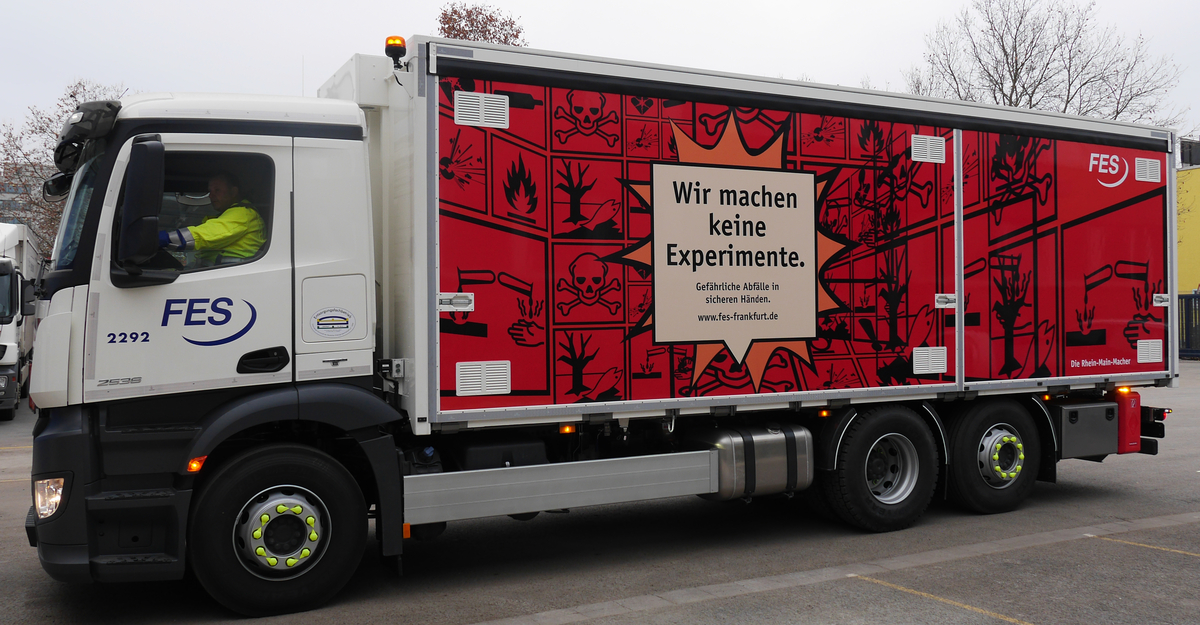
Products with these labels must be disposed of through the hazardous waste collection. For this purpose, the Externer Link zu FES hazardous materials mobile units regularly operate in your district.
Our chemical specialists identify the collected products and sort them into special containers.
Individual advice on environmentally friendly alternatives is also part of our service. Many hazardous products can be replaced or avoided by using products with less harmful ingredients. Pay attention when shopping to whether you really need problematic substances, and in what quantities. Often, less is more, and the seemingly cheaper large bottle only encourages excessive dosing – at the expense of the environment and your wallet.
So dealing with hazardous substances is not that simple, and proper disposal is both a matter of professional expertise and trust. That is why, with our specialized know-how, we are considered the first point of contact for commercial hazardous waste collection.
Information on the collection of hazardous waste
Please note the following when dropping off waste:
- Our specialist staff only accept standard household hazardous waste from private individuals and small businesses (including service providers) registered in Frankfurt am Main. Our staff are authorised to check your identity card if necessary. Individuals who are not registered in Frankfurt am Main can provide proof of identity by presenting a waste collection charge notice.
- Please deliver hazardous waste separated by type and, where possible, in its original packaging. Containers must be tightly sealed. The maximum delivery quantity is limited to 100 kg or 100 litres of total external volume per day. Individual containers must not exceed 20 kg or 20 litres of external volume (10 litres for acids and alkalis).
- Businesses (including service providers!) must generally register their hazardous waste by telephone.
- Please hand over your hazardous waste directly to the specialist staff at the collection point. Under no circumstances should it be left anonymously!
hazard symbols

Explosive
Warning
This symbol indicates substances that may explode under certain conditions (e.g. pressure or temperature). In addition, such substances may pose other hazards, such as flammability or fire-promoting effects.
Handling: Avoid impact, friction, sparks, fire and any heat generation!
Examples: Pyrotechnic articles such as fireworks – however, we do not accept these in the FES hazardous waste collection vehicle!
The previous hazard symbol is replaced by the black pictogram on a white diamond with a red border.
Environmentally hazardous
Warning!
This symbol indicates substances that are hazardous to animals and the environment and can cause short- or long-term damage, such as the death of small animals and/or harm to soil organisms if released into the environment.
Handling: Never let them enter the wastewater or household trash!
Examples: Fuels, heating and engine oils, wood preservatives and solvents, disinfectants and cleaning agents (including those containing chlorine compounds)
The previous hazard symbol is replaced by the black pictogram on a white diamond with a red border.


Hazardous to health
Warning!
This symbol indicates substances hazardous to humans that can cause skin irritation or trigger allergies and respiratory problems. This means that very small amounts do not lead to serious health damage or death. The symbol is also used as a warning for other hazards, such as flammability.
Handling: Avoid contact with eyes and skin. Do not eat, drink, or smoke when using. Avoid inhaling spray mist/aerosols (use sprays only outdoors or in well-ventilated areas).
Examples: Impregnation and lacquer sprays, dishwasher tablets, oven cleaners, solvent-based adhesives, paint thinners, bleaching agents, many concentrates, many detergents
No corresponding hazard symbol exists. In the old labeling system, some hazards were indicated by the “St. Andrew's cross”.
Harmful to health
Hazard
This symbol indicates substances that can cause serious health damage, especially if swallowed or inhaled. Pregnant women are particularly at risk. Substances with carcinogenic (including suspected) or mutagenic effects are also marked with this symbol.
Handling: Use products with caution! Avoid direct contact, for example by wearing appropriate protective clothing.
Examples: Lamp oils, solvent-based adhesives, stain removers, fuels, model-building fuels (methanol), fragrance concentrates
No corresponding hazard symbol exists. In the old labeling system, health hazards were indicated by the “skull and crossbones” or “St. Andrew’s cross”.


Very toxic/toxic
Danger
This symbol indicates acutely toxic products. Even the smallest amounts on the skin or through ingestion can cause serious health problems or death. Most products are not available on the open market.
Handling: Avoid products if possible. When using, do not allow direct physical contact under any circumstances! Wear protective clothing.
Examples: Pesticides/pest control agents, old mercury-containing clinical thermometers/barometers, model fuel (methanol)
The previous hazard symbol is replaced by the black pictogram on a white diamond with a red border.
Corrosive
Danger
This symbol indicates substances, mixtures and products that are corrosive to metals and/or whose contents can cause scarring of the skin, severe skin burns or severe, permanent eye damage after only a short period of contact.
Handling: Protect skin and eyes during use!
Examples: Drain, toilet and chlorine cleaners, limescale removers, oven sprays, bleaches, rust removers, car batteries
The previous hazard symbol is replaced by the black pictogram on a white diamond with a red border.


Compressed gases
Warning
This symbol indicates gases or gas mixtures that are pressurised or liquefied in a container. Cryogenic gases cause cold burns.
Handling: Avoid spontaneous changes in temperature or pressure. Wear protective equipment when handling cryogenic gases.
Examples: Gas cylinders and cartridges, carbon dioxide cartridges (e.g. in sparkling water makers)
There has been no corresponding hazard symbol for this to date.
Fire-promoting
Hazard
This symbol indicates substances that can ignite flammable materials (oxidizing effect) or promote/intensify fires. Mixing with flammable materials can produce explosive mixtures.
Handling: Avoid any contact with flammable materials!
Examples: Bleach, swimming pool disinfectants containing chlorine, multi-nutrient fertilizers
The previous hazard symbol has been replaced by a black pictogram on a white diamond with a red border.


Highly flammable/flammable
Hazard
This symbol indicates products that can ignite quickly near heat or open flames. Combined with water, they may produce flammable gases or self-ignite. In contact with air, liquids can form explosive mixtures.
Handling: Avoid using near open flames and near sources of heat or ignition! Never spray on flames or hot surfaces! Store safely to prevent fire.
Examples: Turpentine substitute, acetone, denatured alcohol, gasoline, spray cans
The previous hazard symbol has been replaced by a black pictogram on a white diamond with a red border.

Sie sind als Gewerbekunde registriert
Sie haben einen Gewerbekundenaccount. Bitte melden Sie sich im FES-KundenPlus Portal für Gewerbekunden an. Dort finden Sie alle Funktionen und Informationen für Gewerbekunden.